


Videos
The Hot Spring:
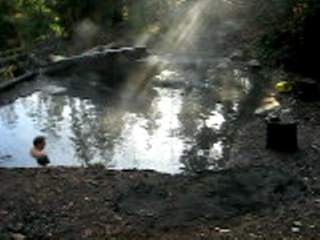
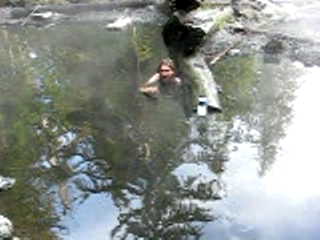
Mount Baker Hot Spring is a very popular spring in the Northern Cascades but it does not deserve the popularity it has. This is probably one of the worst hot springs we have ever been to, due to the about 100-101 degree water which most of the pool is, the high silt content, and the sulfur smell. It is probably only popular because there are not many hot springs in Washington and it is close to Western Washington University. We heard that it was an ok spring in the past but landslides during heavy winter storms filled in the pool with mud that has to be dug out in the spring.
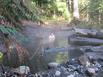
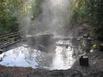
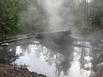
The pool is dug out of the muddy sand and gravel and is about 15 feet across, and 2-3 feet deep. There are two spots where the hot spring water bubbles up from the bottom, and the pool is dug deeper in these locations usually. One of the spots has heavier flow than the other but it is still difficult to get a sweat even when sitting on the spring. The flow is also so low that the heat disipates quickly making most of the pool not quite hot enough at about 100 degrees farenheit. The silt content is also very high even though frequent soakers siphon the silt out regularly. Finally the worst thing about the spring is that due to the low flow and high use it often fails to meet water quality standards for fecal coliform levels, and has tested positive for e-coli.
Historically this hot spring was called Morovitz Hot Springs, named after the original western founder in the 1890's. Originally it had one soaking tub that was built in the 1890's and was not changed until the 1960's. During the 1960's and 1970's the Skagit Alpine Club built a four person soaking tub (which is probably all the flow can accomodate), a changing room, and an outhouse nearby. Then in 1978 the Forest Servise removed all man made structures due to the concerns in water quality and the desire to return to a more natural setting. In the recent years it has been overused making it an almost police state (which it is not anymore), and it has been completely filled in by mudslides in several of the large winter storms.


Yesterday, while I was at
Yesterday, while I was at work, my sister stole my iPad and tested to see if it can survive
a thirty foot drop, just so she can be a youtube sensation. My apple ipad is now
broken and she has 83 views. I know this is entirely off
topic but I had to share it with someone!
obviously like your website
obviously like your website however you need to check the spelling on quite a
few of your posts. Several of them are rife with spelling issues and I
find it very troublesome to inform the truth then again I'll definitely come back again.
I have been to many hot
I have been to many hot springs and there are certainly better ones, but this one is free and still better than one I visited in Utah. I agree that the pond has a strong sulfur smell (which goes away after a while) and large amounts of silt (but your in water and it washes off). However, I found it still pleasant during the weeknights and pretty rowdy on the weekends (with a good redneck contingent that thought my wife and I spinning fire by the pool was the sweetest thing they've seen in a while). I am wondering about getting to it in January with four wheel drive. Is it possible?
You are terrible. Truly an
You are terrible. Truly an awful person
You are terrible. Truly an
You are terrible. Truly an awful person
It may not be the best but an
It may not be the best but an adventure is an adventure. Driving up the dirt roads and finding the springs is a he'll of a lot cooler then sitting at home watching TV
I likey this place! Its fun:P
I likey this place! Its fun:P you can smoke weed, kill frogs, & blow up fire extinguishers! And guess what>?! No one will CARE!! hehe bomb.com
Who would not want to
Who would not want to experience such gift of nature for all of us to take care of and enjoy at the same time. - Mint Springs Farm
Who would not want to
Who would not want to experience such gift of nature for all of us to take care of and enjoy at the same time. - Mint Springs Farm
Hi just wanted to give you a
Hi just wanted to give you a brief heads up annd let yoou
know a few of the images aren't loadng correctly.
I'm not sure why but I think its a linkng issue.
I've tried it in ttwo different internet browsers and both show the same results.
Post new comment